July 19, 2014

Progress in school

In the recent mid-year exam, Yiu Yiu just made it to the upper half of her whole standard three of close to 600 students.  Her BM pulled her down, scoring only 54 for Pemahaman and 68 for Penulisan.  I am still resisting sending her to tuition but it looks like I may have to, sooner or later, as the standards are pretty high.

She submitted an entry for her school’s comic drawing competition few weeks back, and out of the blue, she came home with a trophy, winning an Excellence award for her entry.

 
Yan Yan seems to be progressing ok in her learning – she’s starting to read slowly, can recognize Chinese words that are taught at school and is pretty good at Maths.  The area for improvement that has been consistently highlighted by her class teacher in all the monthly progress report seems to be her lack of self confidence.  She seems to be very sensitive and concerned about what others think about her, and so most times at school, when she cannot grasp what the teacher was teaching, or if she couldn’t complete the work assigned, she’d break down and cry, instead of asking help from the teacher.  She also gives up easily and will simply say “I don’t know” instead of trying and making mistakes.  She seems to have this paranoia about making mistakes, so we gotta give her more encouragement to try.

Nonetheless, when I went for the Parents-Teachers Day, I was very pleasantly surprised to see this – she was Star Student of the Week!


July 04, 2014

School sports day


There are thousands of students in Yiu Yiu’s school, and as such, the school only invites parents of participating students to be present at the sports day (and I think the same applies to all other school activities).

Yiu Yiu was selected to participate this year and so, we were at the school bright and early on that day.
 
Having a quick bite before the events started


It started with the usual marching in of students and uniformed bodies, followed by speeches by the headmaster and chairman of the PTA.  It was followed by some taekwando, cheerleading and unicycle performances.  I was planning to leave as soon as her event finishes as I had to get to Yan Yan’s kindy for Parents-Teachers Day as well.  Unfortunately, her event was the last on the program.


Her team finished second last – one of the girls hopped the wrong way in the gunny sack.  She went backwards instead of forward J  Yiu Yiu was slightly disappointed but I’ve drummed into her that it doesn’t matter if her team won or lost, most important she participated and had fun.  But apparently the poor girl who hopped the wrong way was given an earful by her mum.

This may be the last year she’d participate in her school sports day, as there will no longer be telematches and games from Standard 4 onwards, unless she gets chosen for any track and field events.

June 02, 2014

TJC mid-year party


The theme for the party was Nursery Rhyme, and being the lazy mother that I was, Yan Yan went as Mary, as we had a little lamb hand puppet at home.


Some mothers really put in lots of efforts to create special costume for their children for occasions like this and I salute them.  Whatever it is, she had lots of fun with her classmates and that’s all that mattered.

May 26, 2014

Tainan - Day 2

After checking out from the hotel, we headed to the Chihkan Tower (赤崁樓).  Chihkan Tower was constructed by the Dutch in 1653 and was originally used as the administration center during the Dutch’s occupation.  Its original name was Provintia which means “eternity” in Dutch.

An interesting trivia: the original statues in the foreground has the Dutch general (with back facing us)kneeling in surrender, but two years after it was commissioned, it was changed to a standing posture at the request of the Dutch when Taiwan wanted to purchase submarines from them J
 
Row of nine turtle statues bearing giant tablets from the Qing imperial court


Windows at Chihkan Tower.  Bill Gate may have to pay royalty to Taiwan J
 
One of the temple within is a popular place for Taiwanese to pray for good exam results.  Photo above are all wishes hung on the board at the back of the temple.

The original Fort Provintia was completely destroyed during the Qing Dynasty.  What remains of the original Dutch building is this brick wall.

 
Our next destination was the Confucius Temple.  Built in the year 1666, it was the first Confucius temple constructed in Taiwan and back in the old days, was the highest learning institute in Taiwan, where officials were trained.  Established during hard times, the simple decoration reflects the Confucian spirit of frugality.

 Main entrance to the Confucius Temple.  The granite stele is the “dismount monument” (下马碑), indicating that visitors must dismount from their horses and proceed from this point on foot, to show their respect for Confucius.


The Edification Hall (明倫堂) - this was used for the study of Confucius classics and open only to those scholars who passed the Imperial examinations

 
Chongsheng (崇聖) Hall  – since 1723, the first five generations of Confucius’ ancestors have been worshipped in this temple.  Aside from honoring the birth of a great thinker, it is also to encourage scholars to worship their ancestors, as filial piety is one of the key teachings of Confucius.


There are many statues like this around the Chongsheng Hall but this little fella stood out as the only one with a playful feature

We headed for lunch after that at a hot pot restaurant frequented by locals, San Ta Beef Hot Pot (三大牛肉火鍋).  What’s unique about this restaurant is that they serve fresh, instead of frozen beef, for their hot pot.


After lunch, we went to the Ten Drums Culture Village (十鼓文化村), converted from an old sugar refinery.  This is home to the Ten Drum Art Percussion Group, which I learnt scored a Grammy nomination in the Best Traditional World Music Album category in 2009.  The group has also performed at the Summer Olympics in Sydney in 2000 and the 2002 World Cup in South Korea.

We had a guide who took us on a tour around the village.  We started at the East Asian drum museum with displays of  traditional drums from Taiwan, China, South Korea and Japan.


We were then ushered to theatre for the highlight of the tour, the 30-min Ten Drum show.  Since we weren’t allowed to take pics, I borrowed this photo from here.


We were then taken to the drumming experience room to learn some drumming skills.  We then killed some time walking around the remnants of the sugar refinery.

Drumming class in progress 

Constellation of stars on the ceiling of the cafe 


Remnants from the sugar refinery

We took the high speed train back to Taipei after the visit to the Ten Drums Culture Village.  I’m glad we had the two days break in Tainan before the gruelling 5-day meeting in Taipei.  Mum, on the other hand, went on to visit Taroko Gorge, Sun Moon Lake, Puli, Lukang, Alishan, Shifen and Pingxi with the other mums.  Wished I was in her shoes J

May 22, 2014

Tainan – Day 1

I was in Taipei for work in May, and few colleagues and I, planned a side trip to Tainan.  Since it was Mother’s Day weekend, few of us also brought out mums along for the trip.  One of our Taiwanese colleagues arranged the itinerary for us, and he and his wife even accompanied us for the trip.

We took the high speed train to Tainan, and it took less than two hours to reach Tainan.  Upon arrival at the Chiayi station, we were picked up by our chartered van.  Our first destination was the Taiwan Salt Museum, with a double pyramid structure.  The salt industry in Taiwan dates back over 300 years to the early Chinese settlers.  But with cheaper salt being imported from other countries, this is a dying industry in Taiwan.

 
The museum has four floors of displays detailing the science of salt, the history of the salt industry in Taiwan and the use of salt world-wide.  There are also exhibits on salt industry around the world by with replicas of the salt mine in Poland and well-salt in Sichuan.  But most explanations are written in Chinese, for a banana like me will not be able to fully appreciate and understand the exhibits.

Nicely crafted wax recreations of workers in the salt fields in the 1960s

Model of a well salt production facility in Sichuan

Outside of the museum are examples of salt flats.


Located near the museum is the Qigu Salt Mountain (七股鹽山).  The mountain is a two hectare mound of salt left over from the Taiwan Salt Corporation’s Qigu Salt Fields.  The Qigu Salt Field was once the largest solar salt field in Taiwan supplying salt for the domestic agricultural and industrial sector.  Through changes in time, solar salt was no longer economically viable; hence the Qigu Salt Field ceased production in May 2002, marking the end of 338 years of solar salt history in Taiwan.  It is climbable, with steps carved into the hard salt to make for easy climbing.


Lunch was at Ah Cheng Seafood Restaurant, serving typical local Tainan food.


After lunch, we went on a boat tour around the Qigu Lagoon (七股潟湖), the largest inland lake in Taiwan.  The lagoon is rich in ecological resources with more than 30 species of crabs and 200 species of fish, shrimps and shellfishes.  We also saw plenty of oyster farms.


The tour ended with a feast of eat-all-you-can grilled oysters.
 

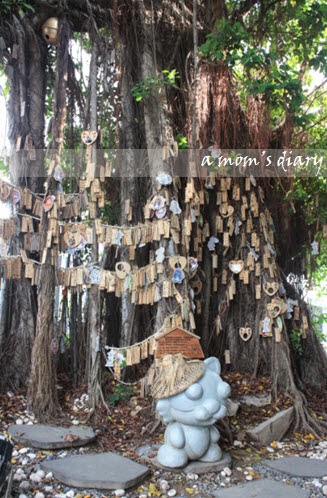
Our next stop was the Sio (salt in Japanese) House.  Established during the Japanese occupation as an official building related to the salt industry, its Japanese-style architecture has been preserved.  In its compound is a century-old banyan tree which has become a wishing tree, with lots of hanging wooden wishing tablets.


Inside the building are exhibits that tell the past history of Anping Salt industry, salt sculptures and special salts from all over the world.  There are also rows of different colored salt representing 366 birth dates and a personality description associated with each one.


We then walked past the Anping Tree House (安平樹屋).  It was originally an office and warehouse of Tait & Co, one of the top five trading companies in Anping area during the period of Japanese colonization.   It was abandoned after the decline of the salt industry in Anping.  A gigantic banyan tree has taken over the warehouse in various ways, including its aerial roots and trunks that have became part of the architecture.  As it was getting late and we needed to cover the Anping Fort, we didn’t visit go in for a visit.


In the early 17th century, European seafarers came to Asia to trade and develop colonial outposts.  In 1624, the Dutch occupied today's Anping and took ten years to build a fort named Fort Zeelandia.  During the Japanese occupation, it was rebuilt and named Anping Fort (安平古堡).  All that remains from the original structure are a few crumbling walls that used to make up the foundation.


The statue of Koxinga (鄭成功) in front of the fort.  Koxinga was a Chinese military leader born Japan.  He led the Chinese military to defeat the forces of the Dutch East India Company (VOC) in Taiwan.


This is part of the better preserved southern outer fort wall.  As there was no cement in the past, the walls of the fort were laid with bricks and glued with a mortar which was a mixture of grounded oyster shell, syrup and glutinous rice.

It was already dark when we left Anping Old Fort so we didn’t have much time to wander around Anping Old Street – just caught glimpses of narrow streets and alleyways packed with vendors, eateries, shops and stores – before heading for dinner at a restaurant named Chou’s Shrimp Roll (周氏蝦卷).  Our delicious course dinner included a sampling of all the famous cuisines in Tainan.

Glimpses of Anping Old Street