August 24, 2008

Angkot Wat Archaelogical Complex – Part 3

Thursday, August 9

It started to drizzle and we made our way back to the van and headed to Ta Keo, a temple built by Jayavarman V (968 – 1001). It was never finished, and thus is missing the elaborate carvings seen at other temples.


One of the most popular of Angkor's many wonders, Ta Prohm was recently used as the set for the shooting of Tomb Raider. This 12th century Mahayana Buddhist temple is one of the Angkorian era's largest edifices and has been left much as it looked when first discovered more than a century ago. The jungle is devouring its structures, with tentacle-like roots of mature trees slowly strangling the stonework, resulting in crumbling structures.


By then, we had been walking for almost 7 hours and it was only slightly after 12 noon. We settled for lunch at some stalls opposite Angkor Wat. After some much needed rest and replenish our energy, we decided to enter Angkor Wat again with the guide, just so that he can regale us with stories of Angkor Wat. As it was still early when we completed the tour of Angkor Wat, the guide brought us to another temple in the jungle, Preah Khan. Halfway through our walk in the temple, it started to pour and we quickly took shelter under whatever little is left standing of the temple. Our driver, John, who was waiting in the van, brought us some umbrellas so we could make our way back to the van. We were all wet with our feet covered with mud, coupled with temple fatigue setting in, we decided to head back to the hotel.

Back at the hotel, we showered and were planning to take a short nap before hitting the Central Market. As we were all spent forces, we ended up sleeping for more than two hours, waking up at about 7pm. We headed for dinner at Dead Fish Tower, a restaurant specializing in Thai and Western food. Sis, mum and hubby ordered Thai food, which was quite good while I had club sandwich.

After dinner, we went across to the Central Market to do some shopping. I bought some books, pirated ones, :-) as they were cheap and of pretty decent quality and bags for myself, babysitter and her daughter.

August 21, 2008

Angkot Wat Archaelogical Complex – Part 2

Thursday, August 9

Thom means "big" so Angkor Thom is "big city" in Khmer. Five monumental gates, each topped by four serene faces of Buddha, mark the entrances into the fortified city of Angkor Thom, the last and most enduring capital city of the Khmer empire. It was established in the late 12th century by king Jayavarman VII. It covers an area of 9 km², and at its height, more than 500,000 people lived within the walls of Angkor Thom. Many amazing and important monuments are found inside Angkor Thom. Two rows of statues guard the entrance to each gate – on the right is a row of god or the good spirits, on the left, the devils of the bad spirits.

The good and the bad

At the Bayon temple, 216 gargantuan faces of Buddha watch over visitors. Built around 1200 by Jayavarman VII in the exact centre of the city, it is one of Angkor's most stunning temples with a staggering 11000 figures carved into the stone walls.


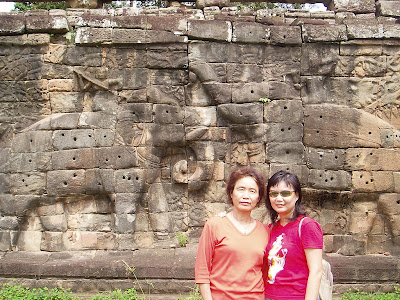
Baphuon sits 200m northwest of Bayon but as it was undergoing massive restoration works, no visitors were allowed in. It used to be the shelter where the people congregate during attacks on the city by foreign forces. The 300m long Terrace of Elephants boasts of stairways with three-headed elephants and retaining walls laden with bas-reliefs of elephants and mahouts in hunting scenes. It was used as a giant viewing stand for public ceremonies and parades, and what else but elephant races!

Terrace of the Leper King, just north of Terrace of Elephants, is a carved 6m high platform, on top of which stands a mysterious statue. Some thinks it's Yasovarman, a Khmer ruler who died of leprosy, while others think it's the Hindu god of Death, Yama.

(to be continued…)

August 19, 2008

Angkot Wat Archaelogical Complex – Part 1

Thursday, August 9


We woke up at 4.30am today, as we need to leave the hotel by 5.00am to head to Angkor Wat to catch the sunrise. By the way, Angkor actually means "city" in Khmer and Wat as most of us knows, means "temple" so Angkor Wat literally means city temple. When we reached Angkor Wat at about 5.30am, there were already scores of people there. Unfortunately again, it was cloudy and we didn't manage to see the supposedly spectacular spectacle. It was only slightly past 6.00am when everyone who gathered to watch the sunset began to leave. We made our way back to the van too, and wasn't quite sure what to do as our guide would only come at 8.30am. We decided to have a picnic near Angkor Wat, as the hotel had packed our breakfast. We had two packets each of fried rice and fried noodles with omelette. When we opened up the container, we were surprised by the extra large servings so we gave one packet to the driver and another packet to a little boy who was hawking some books by the road side. We shared the other two packets among the four of us and we were still stuffed!

When the sky got brighter after we had breakfast, we decided to explore Angkor Wat on our own instead of hanging around till 8.30am. Angkor is the heart and soul of the Cambodia, a source of inspiration and pride to all Khmers as they struggle to rebuild their lives after years of terror and trauma. As we cross the outer causeway to its inner confines, the seven-headed naga (multiheaded serpents) along the causeway become an emblematic rainbow-bridge for man to reach the abode of the gods. Angkor Wat was built by Suryavarman II (1112 – 1152) to honour Vishnu, his patron deity.

Most photos of Angkor Wat reveals three towers, but there's actually five. The two towers on each side are parallel so it appears as if there's only a central tower surrounded by two lesser towers.

Spectacular as it is, it didn't send a tingle down my spine, didn't inspire in me that WOW feeling. Returning to the van, we found our guide had already arrived. As we were already tired out from our own exploration, we declined his offer to take us into Angkor Wat again. The 5-minute ride to Angkor Thom was a welcome relief for our sore feet.

(to be continued…)

August 17, 2008

Blog readibility test

I saw this interesting tool in Kittycat's blog. It tests the readibility of your blog. My fingers itched after seeing it and I quickly went to check it out.

My blog turns out to be...
blog readability test

Try it out, it's fun.

August 16, 2008

Trip to Siem Reap

It has been a year since our trip to Siem Reap. I had written several posts of the trip, all of which were sitting in my Draft box. The queen procrastinator in me had just managed to sort out the photos, which explains why the posts are only coming up now. It's been a long time I know, but I'd like to still post them anyhow, for posterity sake. So be warned, very very outdated posts ahead.

Wednesday, August 8

We woke up at about 6.30am to a sms from Air Asia informing us that our flight has been retimed. It was supposed to take off at about 10.10am, but it's now it's delayed by one hour. Since we already woke up, hubby went out to buy breakfast, instead of having it at the LCCT. The taxi driver came at about 8.15am, and we arrived at the LCCT just before 9am. Checking in was quick, and we had almost two hours to our flight. We killed time by hanging out the Coffee Bean. I even managed to dial in for my t-con from 9 – 10am.

We arrived in Siem Reap at about 12.15noon. Siem Reap, literally "Siam Defeated", commemorates a Khmer victory over the neighboring kingdom of Thailand. The airport was impressive. It looked as if it's a resort by itself. We cleared immigration and collected our luggage, to find our driver waiting outside at the arrival hall. It was a short 20 minutes drive to our hotel, Angkor Star Hotel. We got the VIP treatment at check-in, as the reservation was done by hubby's friend, a Malaysian who's a big shot in the local Angkor Beer brewery. Turned out the owner of the hotel is also Malaysian, and a friend of hubby's friend. The General Manager himself, also a Malaysian, came out to say hello and informed us of the itinerary that his staff has helped arranged for our 3 nights stay there.


After checking into our room, we went out for lunch at a local restaurant, Happy Special Pizza. Lest the name deceives you, it serves a variety of Cambodian food, in addition to pizza and pasta. Mum ordered rice with chicken stir fried in young ginger, sis ordered fried rice, hubby ordered rice with sweet and sour beef, and I ordered fried noodles. Cambodian food is very similar to Chinese. I also ordered mango juice and it was heavenly. It was thick and very sweet, the natural mango sweetness. The person who took our order was also apparently the cook so we waited a while before our food arrived. It was worth the wait, as the foods were delicious. They were not cheap though, each costing between USD2.50 – 3.50. We found out subsequently that that's the normal price range.

After lunch, we traveled about 30 minutes to Chong Khneas, a floating village at the edge of Tonle Sap (Great Lake), the closest and most accessible to Siem Reap. Tonle Sap is the largest freshwater lake in South East Asia. During the rainy season from June – October, the vast lake swells from around 3000 sq km to almost 13,000 sq km. It is one of the world's richest sources of freshwater fish. Many Vietnamese live on the lake, as they are not allowed to build their homes on land. They are somewhat like illegal immigrants in Cambodia. Their living conditions are poor, with a small hut built atop a boat, and 2 – 3 generations eat, live and sleep in that cramped space. The water of Tonle Sap is filthy, as it's a busy waterway with tourist and local boats alike. The water also serves as toilet for the boat people. What's distressing is that they use very same water for all their living needs: cooking, drinking, bathing, cleaning and washing. The reality of the boat people hits you hard, and makes one appreciate all that you have. Cambodians living along the road leading to Tonle Sap isn't much better. Surrounded by patches of rice fields, they live in small huts with palm leaves as the roof and walls. Again, 2 – 3 generations live under the same roof with very sparse necessities.

The road to Tonle Sap

The blue buildings are the village's school and on the right is the basketball court


We then visited Wat Thmey (New Wat), a simple pagoda which claim to fame is a unique glass-walled stupa containing the bones of victims of the Khmer Rouge. Some of the bones were recovered from a nearby well while others are the remains of soldiers who died on a nearby battlefield.

Next, we climbed Phnom Bakheng or Bakheng Mountain to watch sunset. Phnom Bakheng is within the Angkor Wat Archaeological Complex, a World Heritage Site by UNESCO, which encompasses dozens of temple ruins. Atop the mountain is the first of temples of Angkor. Built during the reign of Yasovarman (889 – 910), it is designed to represent the Hindu's mythical Mount Meru, home of the Hindu gods. Unfortunately, it was a cloudy day and we didn't manage to catch the supposedly spectacular evening glow.


Top right: People gathered at Phnom Bakheng to watch the sunset (below right) which was less than spectacular due to the thick clouds

We then made our way back to the hotel to refresh ourselves before dinner. Dinner was at Kulen II Restaurant. The restaurant has the same concept as our Restoran Seri Melayu in Jalan Conlay. There's a buffet spread of Cambodian food with the local Apsara Dance being performed nightly from 8.00 – 9.00pm.

We took a slow stroll to the night market which was about 20 minutes walk away. It was a disappointment. The night market comprises only about 20 stalls and was very quiet. As we were all tired, we decided to call it night and headed back to the hotel.

August 13, 2008

Authentic Filipino food in Kuching

I was in Kuching two weeks ago for a short trip and tried out the Filipino restaurant Pinoy Fiesta Ihaw Ihaw at Padungan Road aka Chinatown. Run by Karen and her Filipino family, you get a taste of authentic Filipino cooking in a simple but cozy set-up.

The restaurant is decorated with Filipino wall decoration, lightings, etc


We ordered their signature dish Crispy Pata (roast pork knuckles), stuffed fish (minced fish meat with plenty of Filipino spices), pumpkin special (pumpkin, long bean, squid and prawn cooked in coconut milk) and Sinigang (tamarind soup with fish head). Instead of white rice, we had garlic rice to accompany the dishes. And instead of plates, they used a rattan serving dish topped with banana leaf – quite unique, and a much nicer presentation. The dishes were good but the Crispy Pata was quite a disappointment. When it was served to us, it was cold and though the skin was crispy, the meat was rather dry. I’ve definitely had better roasted pork knuckles than this. We also had dessert, which tasted like yam cake but it way too sweet. Nevertheless, the menu was extensive and service was fast. I’ll probably go again if I find myself in Kuching.

Clockwise from top left: stuffed fish, Crispy Pata, garlic rice on serving dish, pumpkin special

August 10, 2008

Bookworm tag

I got this tag from Kittycat. Thanks dear for still having faith in me, despite me defaulting some of your earlier tags.

Do you remember how you developed a love for reading?
I don’t quite remember how it developed but even as a primary school kid, I was a librarian and spent two afternoons each week in the library. And as a librarian, I could borrow more books than the average student, and since I had the privilege of knowing when a particular book was due so I could grab it the moment it was returned.

What are some books you read as a child?
Mostly Enid Blyton books, Famous Five, Secret Seven, Hardy Boys, Nancy Drew and the likes. I also read a lot of books on Malay folklore such as Si Tenggang, Mahsuri and many others which I can’t recall now. As a teenager and while in university, my favourites were Mills & Boons and Judith McNaught.

What is your favourite genre?
There’s no favourite genre, simply because I don’t read at all nowadays. But up to a few years back, I was still reading books by Stephen King and Jeffrey Archer.

Do you have a favourite novel?
Not that I can remember, it’s really been such a looooonnnnngggg time since I last read anything at all.

Where do you usually read?
As a kid, it was always lying in bed or on the sofa. Even now when reading anything at all – newsletter, work-related articles, and newspapers on the rare occasions, I’d still be reading them in bed.

When do you usually read?
Mostly when I have to fly long hours, then I’ll have a book on hand. Hardly ever read at home nowadays.

Do you usually have more than one book you are reading at a time?
As you can already guessed from my earlier answers, no!

Do you read nonfiction in a different way or place than you read fiction?
Not sure if I ever did, but certainly not that I can recall.

Do you buy most of the books you read, or borrow them, or check them out of the library?
When I was in school, I always borrowed from the library. Even as a young adult, I used to rent from bookstores – there were a few in SS2 back then but I think they’ve all either moved away or went out of business. I bought quite a fair number over the last few years, mostly non-fiction, self-development books, but these are just gathering dust on the shelves.

Do you keep most of the books you buy?
Yes, they are all still on the shelves, mostly untouched as yet.

If you have children, what are some of the favorite books you have shared with them? Were they some of the same ones you read as a child?
At the moment, YY is still reading books that are appropriate for her age, such as Dr. Seuss and the Ladybird series. I guess when she’s older, I’ll definitely introduce her to all my childhood reads like Enid Blyton. But books are so expensive nowadays so I probably have to scout around for a good public library.

What are you reading now?
Err…clinical papers for work…does that count?

Do you keep a TBR (to be read) list?
Obviously not!

What’s next?
I would really like to read Anne Frank – The Diary of a Young Girl. Anne kept a diary as a way to deal with both the boredom and her youthful array of thoughts when her family was hiding from the Nazi during the Holocaust. Tragically, they were caught and only Anne’s father, Otto, survived. I bought the book when I visited Anne Frank House in Amsterdam few years back but it’s still sitting on the shelves.

What books would you like to reread?
Err…if only I could start reading those that are currently gathering dust on the shelves. Then we can talk about rereading.

Who are your favourite authors?
Err…can I say Enid Blyton, from the good old days when I was actually reading?

Not tagging anyone since most of the people I know have been tagged by Kittycat and allthingspurple. Feel free to do this if you're a bookworm.

August 07, 2008

Friendship Award


Got this award from allthingspurple. Thanks dear for remembering me. I first got to know her not from blogging but from MMB, a breastfeeding forum. Our relationship has since evolved into interaction in the blogosphere.

I’d like to pass on this award to these wonderful, multi-talented people - a handful of whom I know/have met in person, but mostly as friends in blogosphere.

Becky’s Mum
Chanel
Chinnee
Hijack Queen
Jazzmint
Kittycat
Zara's Mama

August 04, 2008

Durian fest – Part 2

Besides the durian fest at sis’s house, we also indulged in durians at home. My little missy is a huge fan of durians. See how she enjoys the fruit. Please pardon her unladylike demeanour.

Yummy, it's finger lickin' good!

Whatcha doin' mummy?

Aarrgghhh! Stop taking my photos!

Since you don't listen, I'll just close my eyes so the camera can't see me!

August 01, 2008

Durian fest – Part 1

The king of the fruit season is back! And this time, I’ve had so much durian that I think I'll probably not crave it for some time. Reason is that BIL brought back durians by the baskets! He works in a construction company and was working on a highway project near Nilai. There are several durian orchards near his project site and he’s been getting them by the baskets for a song – D24, D101, and many other variants which I can’t remember their names by.

Can you believe this was sold for a mere RM10? In fact, we've already had a few before I remembered to take a photo.


Plump, thick yellow flesh - the signature of a good durian

Watch the cholesterol, mum!

The aftermath

He has since been transferred to work on another project, so farewell to cheap (almost free!) durians.